
Sex Offender Checks in Will County
The Illinois State Police registry entry page is the official starting point. A visitor must read and accept its disclaimer before reaching the search form. ISP says the database is updated daily, but a current screen can still depend on information reported by a registrant or a local registering agency. Searchers should note the update limits and contact that agency when an address, status, or date appears wrong.
Will County does not replace the state database with a separate public registry. Within a municipality, the city police department with jurisdiction handles registration. The Will County Sheriff performs that role in unincorporated areas. That split makes the listed registering agency important. It identifies the office best placed to verify local compliance, while the Circuit Clerk holds the underlying Will County conviction file when the case arose here.
The image below comes from the official ISP registry disclaimer and shows the conditions a user sees before searching.
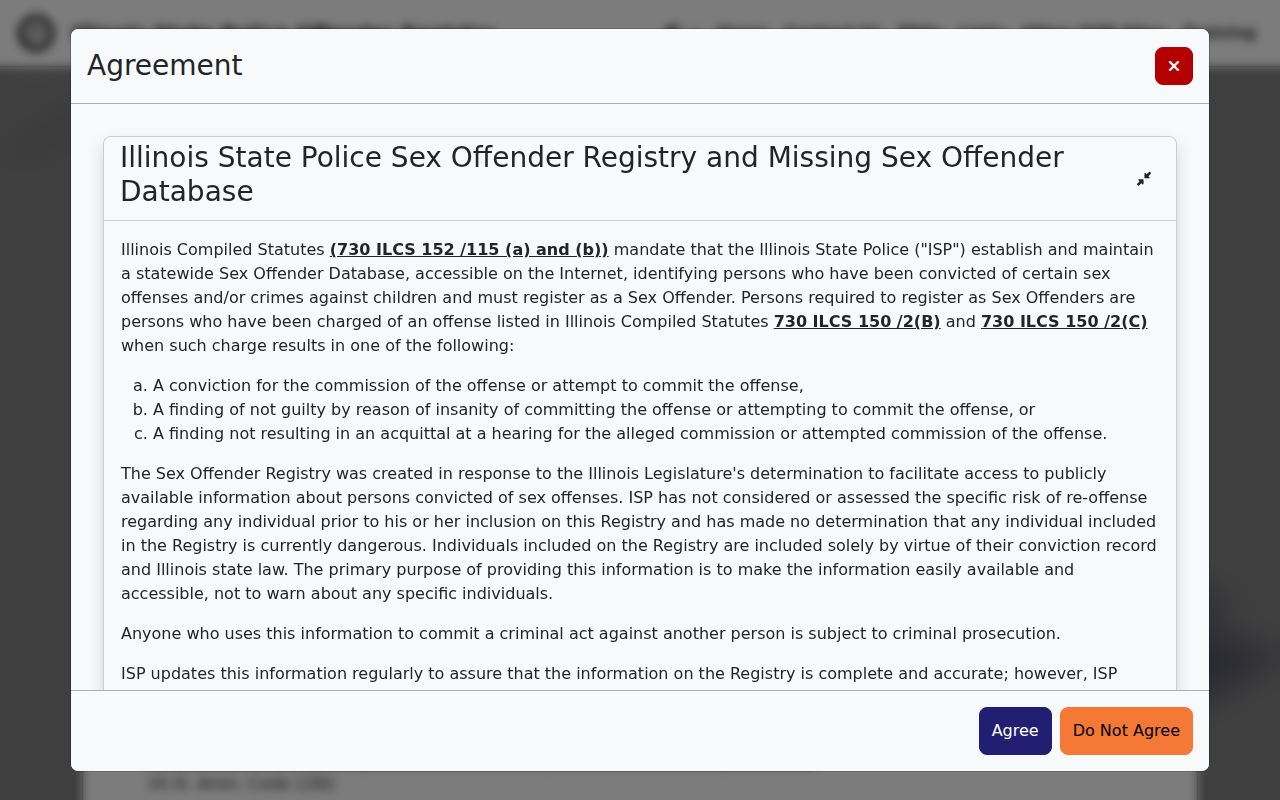
That required entry step reinforces that registry data has a narrow public-safety purpose and known limits.
Will County Registry Disclaimer First
The disclaimer is not a routine splash screen. It says the public database is not a complete criminal history and does not imply that a listed person will commit another offense. A record may also contain self-reported information that needs correction through the registering agency. Those limits matter when a name is common, an address changed recently, or a person appears under an alias.
Use several fields before drawing a conclusion. Compare the photograph, physical description, date of birth, alias information, registered location, and conviction county. Then record the agency shown on the profile. A mismatch should lead to more official verification, not a guess. For a Will County conviction, the contextual court record can be checked through the Will County criminal court case search.
How to Search the Illinois Registry
The ISP Sex Offender Registry search supports both person and place-based queries. ISP recommends entering first and last name at first, then narrowing the results. Too many filters can hide a useful match when an address, spelling, or status changed. The County dropdown also includes incarcerated and out-of-state categories, which are not the same as a current Will County residence.
- Open the ISP disclaimer, read the terms, and select the option to agree.
- Enter a first and last name, or begin with Will County, city, or ZIP information.
- Narrow a broad result with date of birth, status, homeless status, or offender type.
- Open the profile and compare several identity and registration fields before relying on it.
| Field | Type | Required | Use |
|---|---|---|---|
| First Name | Text | No | Combine with surname, then narrow |
| Last Name | Text | No | Primary name field |
| Date of Birth | Date/text | No | Helps separate similar names |
| City or ZIP Code | Text | No | Limits a location search |
| County, Incarcerated or Out of State | Select | No | Includes Will County and nonresident statuses |
| Status / Homeless / Offender Type | Select or checkbox | No | Refines statutory and compliance categories |
| Map Your Neighborhood | Map link | No | Runs a geographic search |
The official search screen shown here reflects the live form and its location tools.
The field mix lets a Will County search move from a broad name query to a more precise official match.
Map Will County Registry Locations
Map Your Neighborhood adds a place-based view. It is useful when the goal is family or neighborhood awareness rather than confirming one known name. A map point should still be opened and read as a profile. Geographic displays may reflect the address or status held by the registry, and they do not prove that a person is present at a location at any given moment.
Jurisdiction also matters. Naperville and Bolingbrook cross county lines, while other addresses can sit in a city or an unincorporated part of Will County. The registering agency shown in the result helps resolve who maintains that entry. Contact city police for an address inside its jurisdiction and the sheriff for an unincorporated address.
Inside a Registry Profile
An ISP profile joins identity, registration, and offense categories in one public view. It is more detailed than a result row but narrower than the court file. The profile can show chronological photographs and registration dates, while the conviction case supplies pleas, court events, judgment, and sentence. No private person's data is reproduced here.
| Name and Aliases | Registered name, alias names, birth date, and alias birth dates |
|---|---|
| Photo and Description | Photo history plus height, weight, sex, and race descriptors |
| Registered Location | Address or official out-of-state, custody, or status wording |
| Registration Detail | Registering agency, original and recent dates, and 10-year or lifetime duration |
| Offense Information | Offense description, conviction county, and permitted victim/offender age statements |
| Category and Status | Illinois category such as Sexual Predator and the current displayed status |
The ISP sample profile source shows how those field groups are arranged; the captured image is used only to explain layout.
Reading each group together is safer than relying on a name, map point, or photo alone.
Will County Registry Is Not History
A registry listing answers a focused statutory question: whether a person appears in the public sex offender system and what ISP is authorized to display. It does not compile every arrest, dismissed charge, nonqualifying conviction, federal matter, or out-of-state court event. It also does not contain the full pleadings and docket behind a qualifying conviction.
When more context is needed, use the county of conviction shown on the profile. The Will County Circuit Clerk holds Will County case files. IDOC is the right channel when a profile indicates state custody or mandatory supervised release. The registering police agency or sheriff verifies local registration facts. Each source answers a different question, so a missing detail in one system is not proof that it does not exist elsewhere.
Illinois Registration Levels and Requirements
Illinois public records are best read through state statutory categories, not a simple federal Tier I, II, or III chart. A standard qualifying sex offender generally registers for ten years, although confinement, violations, and later qualifying events can affect that period. Some categories require registration for natural life. Frequency also changes with status.
| Illinois category | Public duration | Verification framework |
|---|---|---|
| Standard qualifying sex offender | Generally 10 years | Follow current agency instructions; time can toll or extend |
| Sexual predator | Natural life | Annual registration |
| Sexually dangerous or sexually violent adjudication | Natural life | Every 90 days |
| SORA violation conviction on or after July 1, 2005 | For the registration period | Every 90 days |
| No fixed residence | Category-dependent | Frequent reporting under current rules |
The initial registration fee is $100, followed by a $100 annual fee, with statutory provisions for inability to pay. Registration and change reports go to the city police with jurisdiction or the Will County Sheriff in unincorporated territory. The ISP registry FAQ provides the current state explanations.
The official FAQ helps distinguish duration, reporting frequency, and the state's own category terms.
Correcting Will County Registry Information
If a Will County result seems inaccurate, first save the profile details that identify the entry and note its registering agency. ISP directs correction questions to that listed agency. City police can review a municipal registration, while the sheriff can address an unincorporated Will County registration. Suspected noncompliance should also go to the law-enforcement agency with jurisdiction.
Do not attempt a personal visit or confrontation. A difference between a registry profile and a court docket may reflect timing, a reporting issue, or the fact that the two records serve different purposes. Ask the official custodian to verify its own record. If the dispute concerns the conviction file, use the Circuit Clerk in the county of conviction.
National and Will County Searches
The ISP registry is the direct source for Illinois entries. When an address history or known connection crosses state lines, the U.S. Department of Justice National Sex Offender Public Website provides a multi-jurisdiction layer. It searches participating jurisdictions but does not replace the state or local office that owns a record.
The official NSOPW search is shown below as the cross-state option documented for Will County research.
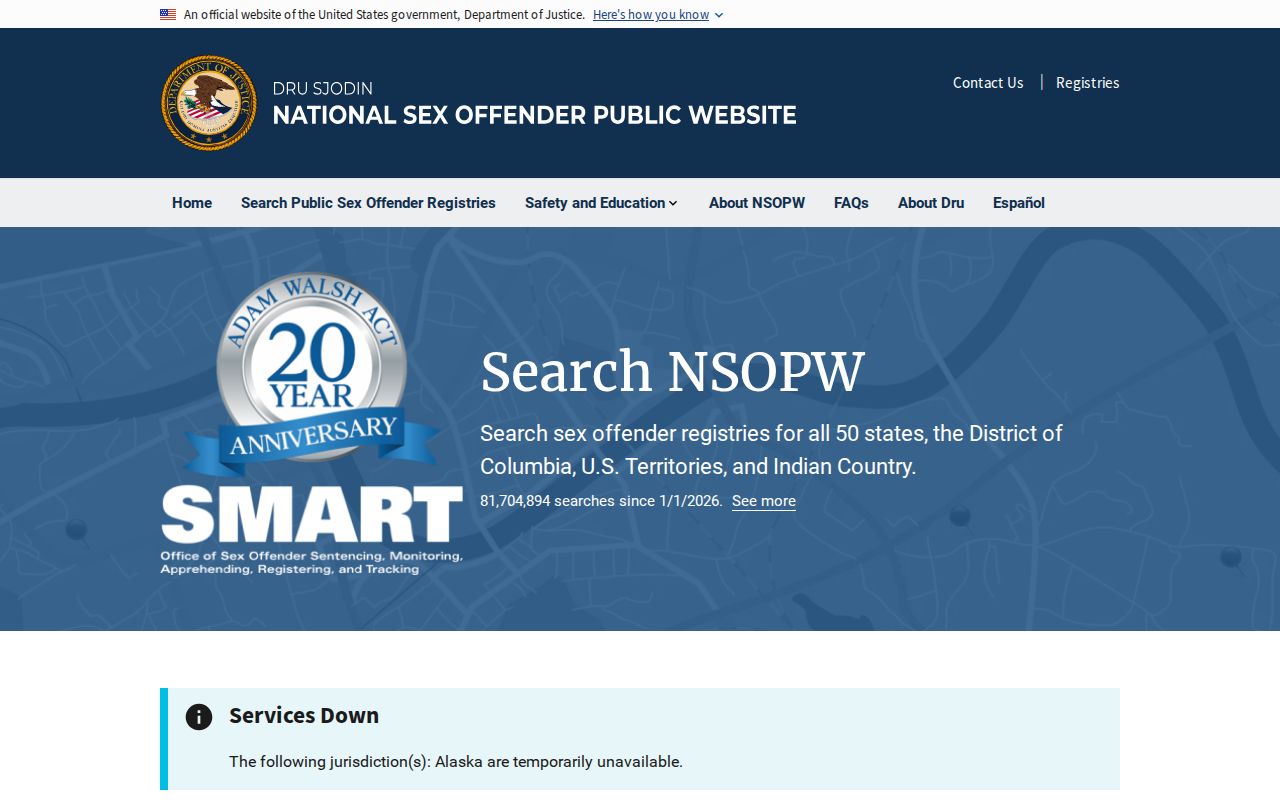
A possible match should return the reader to the contributing jurisdiction for the current profile and local verification.
Community Notification and Lawful Use
Illinois publishes registry information for awareness and safety planning. It may support a household discussion, a review of nearby entries, or a careful check of a known profile. It cannot predict future conduct. Searchers should avoid spreading screenshots without context and should rely on the official live record when accuracy matters.
The Sex Offender Community Notification Law, including 730 ILCS 152/115, governs the public statewide database. The Sex Offender Registration Act, 730 ILCS 150, supplies registration duties and categories. Report a safety concern or suspected violation to the proper police agency rather than acting on it personally.
Use Registry Data Lawfully: ISP warns that registry information may not be used to harass or threaten registrants or their families; harassment, stalking, and threats may violate Illinois criminal law.